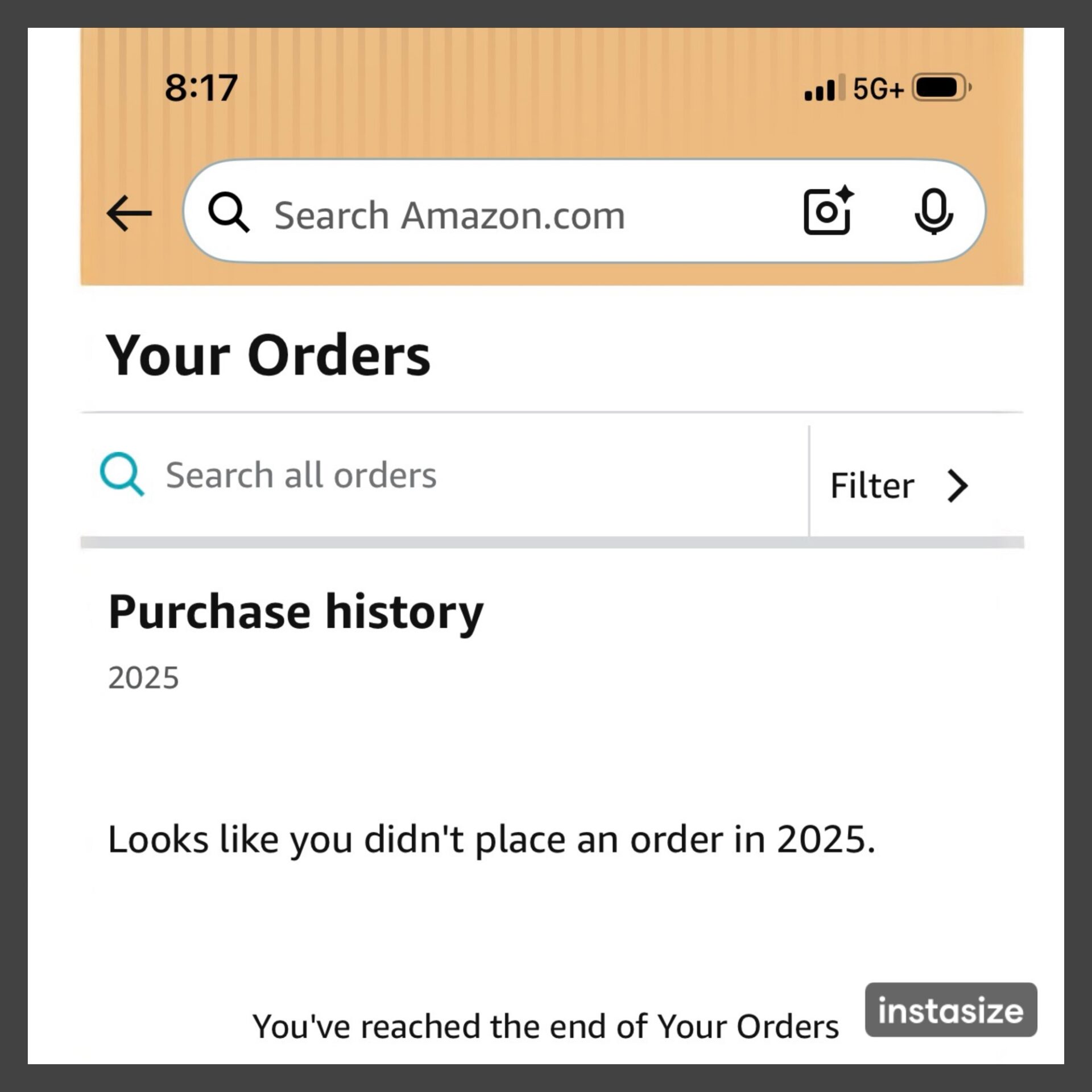
Somehow, this is one of the more controversial conversations I’ve had in the last year and a half. The decision to stop using Amazon was the result of several different factors, but initially it started with one of the more motivating reasons: Saving Money.
We were late to the Amazon train. By the time COVID hit, and everyone was stuck at home, we had barely started using Amazon to help with some of the essentials. Naturally, it was the easiest way to get the things we needed to perfect our newly-formed hobbies. As an added bonus, I was pregnant with J. Without being able to walk through places like Target and Ikea, I heavily relied on online ordering.
Before I knew it, we were just as hooked on the convenience, and regularly contributing to the millions of dollars spent ordering from Amazon daily.
Here’s how we started the conversation around letting it go, and the number of things that it affected.
Less Money Spent.
This was the most obvious.
A few years ago, I found an instagram account that promoted financial awareness, and I was immediately curious how our spending compared.
Taking some time at the beginning of the year, we collected all of our bank and credit card statements, and sorted out the purchases, bills, investments, and miscellaneous spending. I am a productivity-enthusiast who especially loves math. This has become something I genuinely look forward to every year.
The first time was mind-blowing. If you haven’t taken a deep dive into your own finances, I strongly encourage it, at least once. There is a good chance you don’t know your money as well as you think you do, but that’s a much longer blog.
I started categorizing things: Groceries, Bills, Pool Maintenance, Child Care, many others, and then casual spending. Some shops didn’t warrant their own category, but some did. Home Depot and Amazon were among those that had enough of their own spending to qualify for their own column.
Like I mentioned, we were pretty sporadic on our ordering, usually we wouldn’t make more than one order a month, but occasionally two. Closer to the holidays was its own beast, and orders might amp up a little. All that being said, our little family of 3 at the time still spent about $5,000 in 2024.
That was really enough for me. I had a number of projects on my list that $5,000 could cover. Without looking at the history of 2024 purchases, I knew that of all the things I had bought, most of them we could have lived without.
Just so the message doesn’t get mixed up – if you are able to use Amazon as a tool to make your life easier, subscribe for actual necessities, and manage to ignore all the other shiny things on there, I would love to hear what’s is like having that kind of self-control. Please write a book. I promise, there are a lot of us out here trying to learn that discipline.
This leads me to the second most obvious reason to remove Amazon from our life. We already have too much sh*t.
Less stuff.
We did not stop brushing our teeth in 2025 because our subscription for toothpaste tabs no longer existed. Our kids birthday parties were still magical without the themed balloon arch, and everyone on our Christmas list still got a thoughtful gift.
What we no longer had coming into the house was all the extras.
Adhesive all mounting strips for surge protectors.
A dozen mini heart-shaped piñatas.
The literal ton of clothes that were bought and returned, or the few kept items that never lasted long.
The rechargeable everything. (Seriously, everything is recreahable at this point.)
The small variety box of sticky mustaches and beards. – tbh, I don’t regret this one at all.
The kitschy kids clothes and trinket.
Realizing that the grumpy face stress ball I bought a friend was likely just collecting dust on their desk or had already made it in the trash.
I was no longer letting myself fall for the “Kid’s party favors you didn’t know you needed”, or the “Top 20 must-haves to make your house look way more expensive than it is”.
Seriously, whoever it was at Amazon that decided to start using the phrase Must-haves, should be able to live off of those royalties for the next 200 years. But are they actually must-haves?
I’ve washed my dishes a million times, and I find my ability to tackle that task the exact same whether or not I have a stone drying rack for my sponge.
Not everything about giving up Amazon is a win though. Some of it just feels like added stress.
Be prepared to have to search.
In March of 2025, a few months after swearing off Amazon for the year, Martha May strolled into our lives. A sweet little dachshund with a slightly troubled past that made her a little anxious.
At one of her first visits, I remember talking to the vet about her intense separation anxiety. I have had dachshunds in the past, and I know that if they could crawl under your skin, they would. Martha was more attached than this. Her last owner had left unexpectedly, leaving no time for transition. Once she realized I was safe, she followed me room to room and would sit and sleep on my feet to be sure I didn’t leave without her knowing.
The vet and I talked through giving her time to settle and then after a set amount of time, if things weren’t feeling better for her, we could introduce a medication. In the meantime, it didn’t hurt to consider natural alternatives to help. The vet suggested a dog pheromone collar.
It sounded like a great idea, so I asked where I could get one.
“Amazon.”
That was the whole response. No reference to local shops, or even big brand stores in the area. The answer was Amazon, as if they held a monopoly on pheromone collars.
Obviously, there are other places and collars are very easy to find, but the confidence in that answer would have led you to believe otherwise.
The second time I came across an issue was when we were trying to find prizes for our Annual Halfy-New-Year Party (Completely unrelated..)
I posted in a work chat channel:
“Hey! I’m looking for prizes for an event I’m hosting. Anywhere between $30-$50. What would y’all want to win?”
When I tell you that thread blew up with Amazon links, I am not kidding. They weren’t bad things either; a desktop coffee heater, a skin care kit, car-cleaning supplies, but all of it was Amazon.
If you suggest to someone that they should buy something specific, did it even happen if you don’t link the amazon shop?
Spoiler: We went with local events as prizes. Not one amazon link was clicked during the making of that party.
Increased Thoughtfulness.
This might sound like a stretch, but maybe if I explain it well, you’ll feel it too.
We host Christmas at our house each year. Most of my close family is there, including my sister and her twins, and in 2024 they had just turned 7.
I spent a good amount of time around them, and I knew some of their interests and what made them excited.
I didn’t consider either of those when I ordered my niece a light-up paintable moon ball from Amazon.
Seemed cute. You paint it, insert the bulb and cord, and it came with a stand. You could use your own artwork as a night light.
Also, it was on the Amazon must-haves list of kid’s toys. Bought, wrapped and labeled.
Everyone comes over, we are in this chaotic moment of unwrapping presents and I hear my sister say something to my niece like “wow, you’re going to have a lot of those.”
Turns out, it was 1 of 3 she got that year. She still seemed excited, but also as a kid, opening the same gift 3 times doesn’t feel great.
I don’t think that all 3 are painted and set up, and honestly, even if they were, is a 7 year old really happy about getting 3 things that are one and done, and then sit on a shelf?
Since then, I’ve paid much closer attention. Turns out she’s obsessed with food prep and learning to cook. The next gift-giving event, I gave her a set of kids knives from forsmallhands.com, an online Montessori toys site that lets you contribute to schools when you shop.
Full transparency, you can find kids knives on Amazon, likely a little cheaper, but it didn’t seem worth it to me.
There is another big win, though.
Making an impact.
This feels debatable, but this seems like a measurable benefit to me.
Thinking about my $5k in spending, I was never on Prime, so I didn’t receive my packages for 3-5 days – like the cavemen used to do.
But it still seems pretty wild when you think about it. An Amazon employee just packed something I ordered, in a box 3 times its size, placed it in a large delivery van with hundreds of other items, drove it all around my city before creeping into my neighborhood, and tossing it on to my front porch.
And its toothpaste tabs. That seems like a lot of unnecessary steps for a thing that can bought almost anywhere. Seriously, Home Depot sells toothpaste.
These are 3 things that kept coming to mind.
- While Amazon has over a million employees, it’s not the buyers that are helping them keep their jobs. As the industry and the world continue to change, companies like Amazon – and literally everyone else – will continue to see where AI can not only start filling in gaps, but become full on load-bearing walls to support financial growth.
- They thrive on impulse purchases. Even if you have a realistic grip on your shopping, can you really say “Never have I ever added to cart based on an amazon ad?”
- There is no waste management plan. Sure, you can buy it, try it, and return it all within a week. Does it actually go back on a shelf to be sold again? If it does, is anyone responsible for quality control? In the cases where returns are just trashed, where do you think that ends up?
Even removing the consideration of returns, what about all the stuff that’s kept?
If you haven’t already check out the documentary Buy Now! The Shopping Conspiracy. Over consumption isn’t a fad, it is a societal expectation.
If not here, then where?
I’m actually going to end on one of the downfalls of yeeting Amazon out of our lives. The loss of small conveniences.
During the 4th of July last year, our neighbors and some of their friends were lighting fireworks next door.
I wouldn’t say they were wild, but somewhere between standard bottle rocket usage and Badassical Blasts. (I checked, that’s a real name of an explosive firework.)
Anyway, one stray spark found a pile of unused fireworks which lead to chaos and some unexpected launches.
After the smoke cleared, literally, I saw the ring cam footage, it was a crazy amount of smoke, they went back to what they had left, sure to cover the ones not currently in use.
Our little fam was huddled inside with a sound machine turned all the way up. We had some puppy downers for Martha and a loud movie for J. we didn’t realize anything was happening.
K decides we should close the garage, and just as she opens the door, we realize it’s too late.
A stray rocket found a bag of paper shreds waiting to be composted. The back corner of our garage was in flames, but VERY fortunately it was the things in the garage that were on fire, and not the house itself.
Right before K had walked out, our neighbors had realized a stray bottle-rocket had landed in our garage and came over to help put it out.
I will save all the details, but we did get to use a fire extinguisher. The smell was awful, and we have some ruined items, but everyone was safe.
I thought about a friend who had just posted a few months earlier about her garage catching on fire, but by the time they realized, it was too late. Her goal was to get kids and pets out, which she did before watching their house burn in the middle of winter.
I’ve gotten way too far into this, but as a parent and a homeowner, I panicked. I immediately started looking online for the most dependable garage alarm.
They are slightly different than a regular smoke alarm to prevent false alarms due to heat and car exhaust.
No one had them locally, and ordering for shipping in 1-2 weeks felt like too long. However, Amazon has them and was willing to commit to next-day delivery. We didn’t commit to it but in that moment, I saw the other side of the coin.
To me though, there isn’t enough of these moments to counter all the others. I also know that I can’t trust myself, or my algorithms, to keep me from spending money on things that really don’t need to exist.
Using Amazon, we were able to figure out who made the alarms. We found their individual site, and I was able to place and order there directly. Win, win.
Take the plunge. Start with a month. Start by checking your cart and seeing what is available near by. Limit your spending, if you can. Of don’t make any changes. If it works for your family, keep doing it.